


Maria Skłodowska-Curie, Autobiography, quoted by Culture.pl and Aleksandra Jagielska: ‘I saw only one explanation – that there must be some unknown but very active substance in these minerals. When starting this work, however, none of us could have foreseen that it would create a new branch of knowledge in which we would work until the end of our lives[/quote].’
Polonium and radium
Maria Skłodowska-Curie, supported by her husband Pierre, discovered the chemical element while conducting research for her doctoral dissertation on uranium radiation. In 1898, she gave it a name: polonium (Latin). In the laboratory, she also came to two other breakthrough conclusions: radioactivity is measurable and is one of the properties of atoms (today we know more precisely that it is the nucleus of the atom).
The discovery of polonium led Pierre Curie to abandon the subject of personal research (on crystal growth) and join his wife to concentrate his energies entirely on the analysis of radioactivity. A few months later, determined Maria discovered a second element, which she named radius (Latin), or radium.
In later years, she confirmed her findings, arriving at the chemical isolation of the two elements.
Maria Skłodowska-Curie, Autobiography, quoted by Culture.co.uk: ‘And here, in a shabby old shed, we lived out our best and happiest years, devoting whole days to work. Sometimes I had to spend the whole day stirring the boiling mass with a heavy iron rod, almost as big as myself. I was often really overtired. At other times, the work again consisted of extremely fine and delicate partial crystallisation aimed at concentrating the radium solution.
Nobel x 2
In 1911, Maria Skłodowska-Curie was awarded the Nobel Prize in Chemistry for the discovery of two elements and the obtaining of pure radium. This was her second such honour. She had received her first Nobel Prize a few years earlier (in 1903) together with her husband Pierre and Henri Becquerel in the field of physics, for the discovery of radioactivity.
Maria Skłodowska-Curie was the first woman to have been honoured with a Nobel Prize, and to this day she remains the only woman with this award in two scientific fields.
The double Nobel laureate died of leukaemia in an Alpine sanatorium in France on 4th July 1934. It is acknowledged that her illness was a consequence of long-term exposure to radium. She was buried in the Curie family grave in the cemetery in Sceaux, where she had married Pierre years before in the backyard garden.
He now rests in the Paris Pantheon. This particularly important tomb also contains her husband, who was tragically killed in 1906 when he was hit by a horse-drawn goods cart.
Maria Skłodowska-Curie and Pierre Curie had two daughters: Irene and Eve. Irene followed in her parents' footsteps, devoting herself to physics and chemistry. She is also a Nobel Prize winner along with her husband, Frederik Joliot-Curie.
On the murals
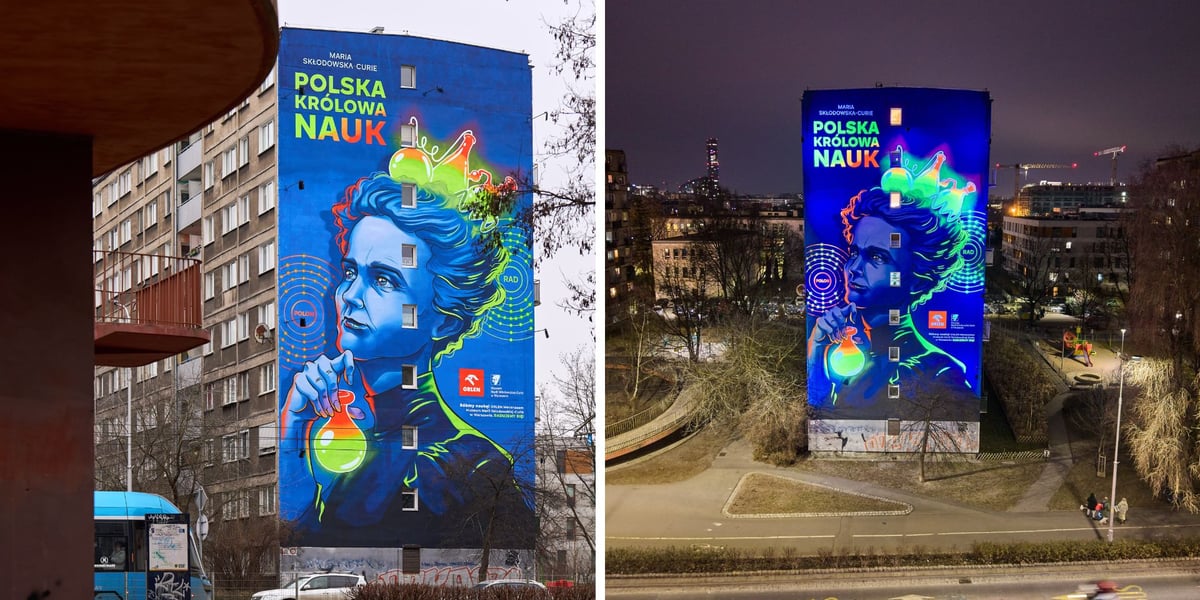
Murals dedicated to Marie Skłodowska-Curie appeared in Wroclaw and Łódź in the first weeks of 2026. It is likely that a similar one will be built in Kraków, as well as in other cities. This is because the murals are part of Orlen's campaign resulting from a partnership established with the Maria Skłodowska-Curie Museum in Warsaw.
In our city, ‘POLSKA KRÓLOWA NAUK’ [‘POLAND KINGDOM OF SCIENCES>>'<<] is present on the wall of an eight-storey block of flats on Legnicka Street in Szczepin – not far from the Solidarity Square. It is a work of the Good Looking Studio agency.