


The most important information (click to go)
A bridge that delights visitors
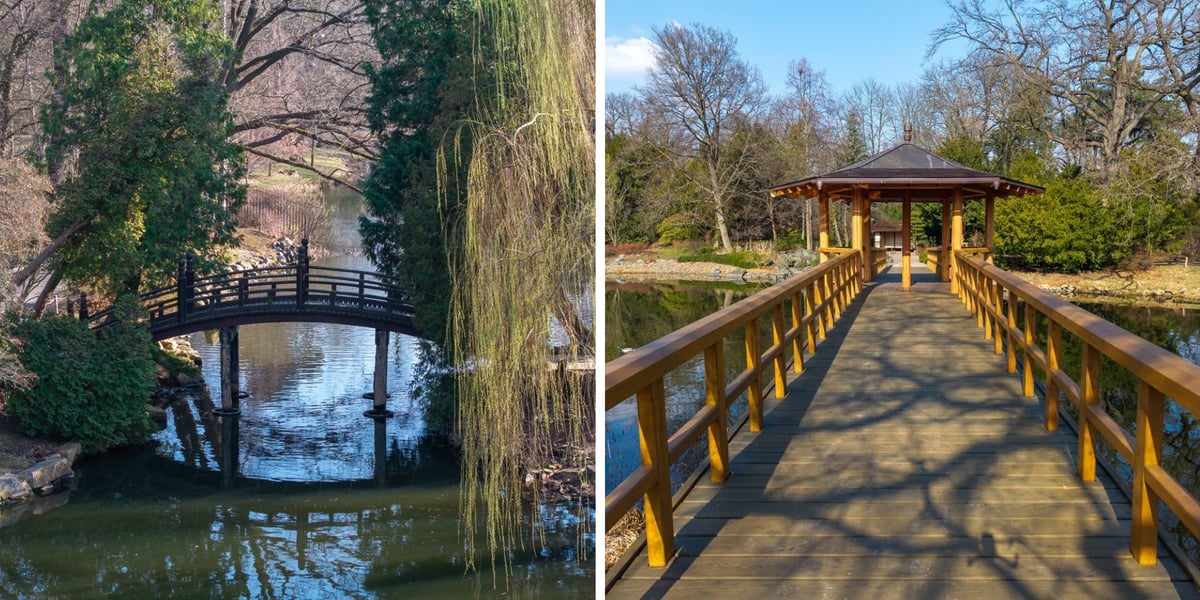
One of the main attractions of the Japanese Garden is the ‘Yumedono Bashi’ (a wooden bridge over the pond). As always, it will delight the people of Wroclaw and visitors alike.
Work was also carried out in the garden ahead of the season – the wooden structures were repainted and maintained, and additional trees and shrubs were planted, such as the ‘Globosum’ Norway maple, the varnish tree and the ‘Yakushima’ rhododendrons.
The Japanese Garden in Wroclaw – which plants are worth seeing
At the start of the season, many of the plants will not be in full bloom yet, but it is worth coming back here, especially as the collection of the Japanese Garden comprises around 200 species of trees, shrubs and flowers.
Some of them – oaks, yews, yellow azaleas and Katawba rhododendrons – date back to the garden’s earliest days in the early 20th century.
The garden contains around 30 species of plants from the Far East and Japan. These include the golden larch, the ginkgo, the hornbeam maple and the Japanese pagoda tree. Visitors can also admire the dawn redwood, Japanese maples, Korean pines and a few dozen varieties of rhododendrons and azaleas.
It is also worth seeing niwaki trees, namely: the Japanese white pine, the Japanese cypress and the Japanese holly.
A separate system, though not a less spectacular one, is the layout of streams, waterfalls and ponds in the Japanese Garden.
Japanese Garden – opening hours
The Japanese Garden is open from 1st April to 31st October, from 9 a.m. till 7 p.m. The entrance is located in Szczytnicki Park, between the Pergola and Mickiewicza Street.
The Japanese Garden in Wroclaw – how much do admission tickets cost?
Full-price single ticket
- Full-price single ticket – PLN 30
- Full-price single ticket for participants in the Nasz Wrocław [Our Wroclaw] programme – PLN 24
- Full-price single ticket for participants in the Nasz Wrocław Max programme – PLN 21
Discount single ticket
- Discount single ticket – PLN 20
- Discount single ticket for participants in the Nasz Wrocław [Our Wroclaw] programme – PLN 16
- Discount single ticket for participants in the Nasz Wrocław Max programme – PLN 14
Full-price multi-entry ticket (10 entries, 1 entry per day)
- Full-price multi-entry ticket – PLN 200
- Full-price multi-trip ticket for participants in the Nasz Wrocław [Our Wroclaw] programme – PLN 160
- Full-price multi-entry ticket for participants in the Nasz Wrocław Max programme – PLN 140
Discount multi-entry ticket (10 entries, 1 entry per day)
- Discount multi-entry ticket – PLN 140
- Discount multi-entry ticket for participants in the Nasz Wrocław [Our Wroclaw] programme – PLN 112
- Discount multi-entry ticket for participants in the Nasz Wrocław Max programme – PLN 97
Family ticket (2 adults and 2 or more school-age children)
- Regular ticket – PLN 80
- Ticket for participants in the Nasz Wrocław [Our Wroclaw] programme – PLN 64
- Ticket for participants in the Nasz Wrocław Max programme – PLN 56
Free entry
- Children up to 3 years old
- People with a certified disability who hold a relevant document
- People under the age of 16 with a certified disability, accompanied by a carer and a guide dog
- Licensed tour guides
Japanese Garden in Wroclaw – history
The garden is part of Szczytnicki Park, near the Pergola and the Centennial Hall. It was built at the beginning of the 20th century, on the occasion of the World Exhibition held in Wroclaw in 1913. The project was initiated by Count Fritz von Hochberg, who engaged a Japanese gardener Mankichi Arai.
After the event, the structures were dismantled, but some of the original vegetation, the layout of the paths and the pond have survived.
The idea of revitalising the Japanese Garden did not emerge until the 1990s. The restoration work, carried out with the help of specialists from Japan, took three years, but the people of Wroclaw could enjoy the new venue only for a short time.
Two months after being opened, the garden was destroyed by flooding, and 70 per cent of the newly planted plants were lost. We had to wait for the next opening of the Asian enclave until October 1999.
Today, the Japanese Garden is one of the most popular places to stroll for locals and tourists. In addition to a few hundred species of original plants, trees, shrubs and flowers, its premises feature structures modelled on Japanese architecture, such as a gate and a tea house.
One of the garden’s attractions is a pond containing giant carp and other species of fish. Tea-making demonstrations, concerts and outdoor events are often held there.